
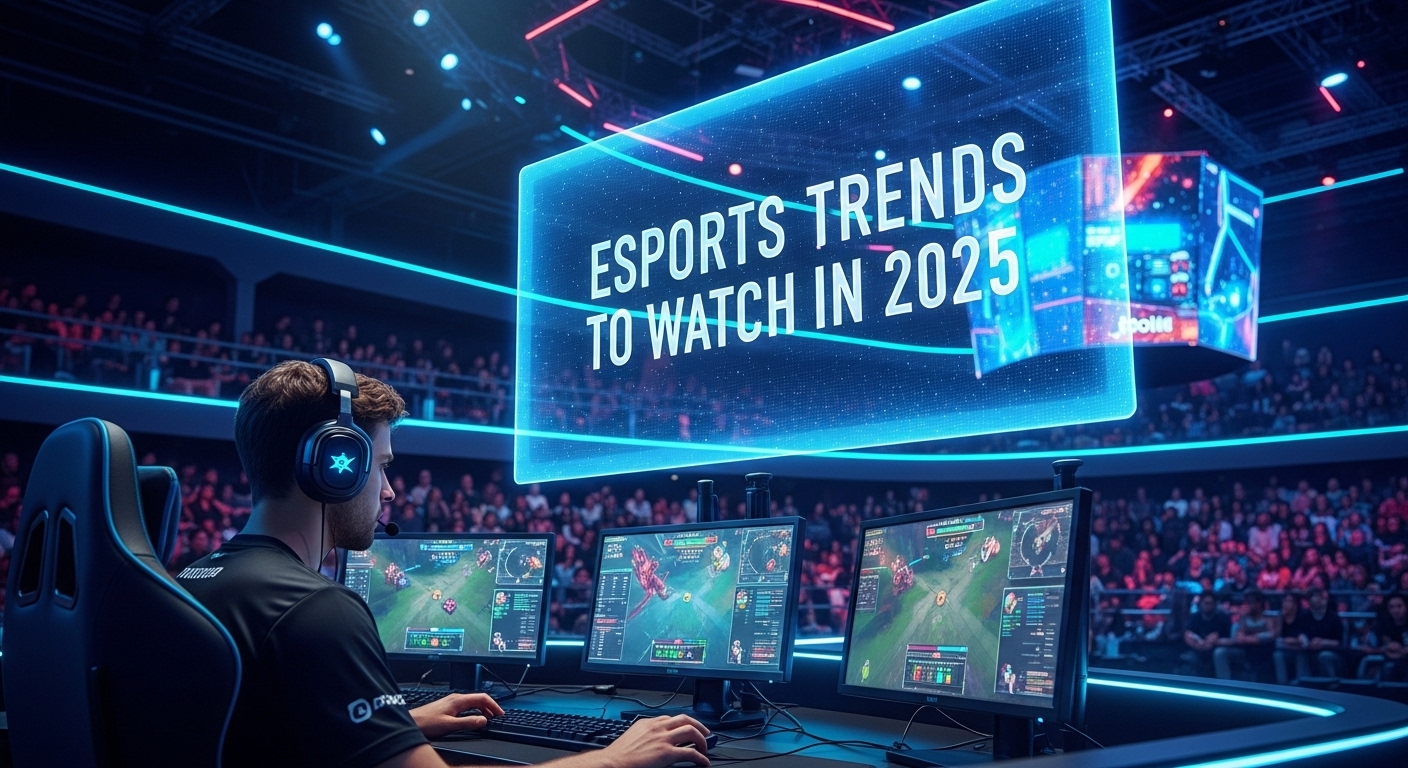
Meta title: Esports in 2025 — Key Trends, Stats & Opportunities for Teams, Brands & Creators
Meta description: Discover the top esports trends for 2025: market size, mobile-first viewership, AI & cloud, monetization, regulation, and practical strategies for teams, brands and creators. Actionable tips + SEO-friendly content ideas.
Table of contents
- Executive summary
- Market snapshot: numbers that matter (2025)
- Why 2025 is a turning point
- Top trends to watch in 2025
- 4.1 Mobile-first becomes mainstream
- 4.2 Audience growth & fan segmentation
- 4.3 Sponsorships, creator-driven ROI, and new monetization
- 4.4 Franchising, consolidation and professionalization
- 4.5 Cloud streaming, cross-platform play and viewability innovations
- 4.6 AI: competition, coaching, content and production
- 4.7 Betting, regulation, and integrity infrastructure
- 4.8 Creator-economy teams, event formats & hybrid entertainment
- 4.9 Diversity, women’s esports and grassroots ecosystems
- 4.10 AR/VR and immersive live experiences
- 4.11 Sustainability and the live-event rebound
- 4.1 Mobile-first becomes mainstream
- What teams, brands and creators should do now (practical playbook)
- SEO & content ideas for esports publishers in 2025
- FAQs (for featured snippet / voice search)
- Conclusion: play the long game
1 — Executive summary
Esports in 2025 is not just “bigger” — it’s deeper, more commercialized, and more segmented. The global games market is maturing (console and PC cycles are driving spend), esports audiences are growing and shifting to mobile-first consumption, sponsorships and marketing are becoming more ROI-driven, and technology — especially cloud streaming and AI — is changing how competitions are produced, watched and monetized. For teams, brands and creators the opportunity is to move from hype-driven activations to measurable, platform-first strategies that meet fans where they already are.
2 — Market snapshot: numbers that matter (2025)
- The total global games market is projected at about $188.8 billion in 2025, reflecting growth but also a more concentrated landscape dominated by China and the U.S. (platform mix is shifting, with console growth notable). Newzoo
- The esports industry itself is forecast to be worth around $3.7–$4.8 billion in 2025 depending on definitions and which revenue streams you count (sponsorships, media rights, advertising, ticketing, merchandise, betting/mobile). Several market reports converge on mid-single-digit billions for esports core revenues in 2025. BDO+1
- Global esports audience estimates for 2025 are ~640 million total viewers (around 318 million enthusiasts + ~323 million occasional viewers), showing continued audience expansion. esportstats.co+1
(These headline figures are useful anchor points — later sections break down where this money and attention are actually flowing.)
3 — Why 2025 is a turning point
The period 2020–2024 saw explosive growth and experimentation. By 2025 the industry is shifting from experimentation to optimization. That means fewer “novelty” bets and more investments in durable assets: league structures, stadium experiences, creator-led IP, and tech that improves watchability (cloud, low-latency streaming, AR overlays). Brands now expect clear KPIs, and regulators are sharpening their focus on gambling, data privacy and player welfare. In short: 2025 is when esports must prove it can deliver predictable business outcomes at scale.
4 — Top trends to watch in 2025
4.1 Mobile-first becomes mainstream
Mobile gaming and mobile viewership have crossed from “emerging” into core. Mobile games continue to drive player counts and increasingly drive esports viewership, especially across Southeast Asia, Latin America, South Asia and parts of Africa. Mobile-first events (shorter formats, vertical video content, integrated creator features) are optimized for discovery and social sharing on phones — where the next generation of fans spends most of their attention. Industry trackers show mobile retains a majority of gaming revenue and mobile esports titles (and mobile adaptations of PC/console hits) are dominating peak viewer lists.
Why it matters: Sponsors targeting mainstream reach should design creative for vertical video, short highlights, and in-app activations that convert mobile attention into product lift.
4.2 Audience growth & fan segmentation
Esports audiences are no longer monolithic. By 2025 we can meaningfully segment fans into:
- Core enthusiasts (tournament watchers, bettors, fantasy participants)
- Casual viewers (tune in for big finals or creator streams)
- Social consumers (watch clips, highlights and UGC on TikTok/Instagram/Shorts)
Estimates put total esports viewership ~640M in 2025, with mobile accounting for a large share of watch hours. Understanding which segment you’re targeting determines the product — long-form broadcast, microcontent, or community-centered experiences.
4.3 Sponsorships, creator-driven ROI, and new monetization
Sponsorships are maturing from logo placements to integrated product experiences. Brands demand measurable outcomes—traffic, purchases, installs—not just impressions. At the same time, creator teams and streamer-first tournaments let brands reach audiences in a more authentic voice.
Expect:
- Performance-driven sponsorship deals (affiliate-style links, promo codes, in-stream commerce).
- More native brand integrations inside game titles or event microsites.
- Growth in esports marketing budgets passing $1B in various measures as agencies reallocate spend into gaming ecosystems.
Practical tip: Create pilot activations with clear tracking (UTMs, promo codes, in-app referral) and a short feedback loop — show brands 30-day conversion lifts or social engagement that justifies renewal.
4.4 Franchising, consolidation and professionalization
Top leagues continue to professionalize: franchise fees, tighter broadcast standards, and long-term media deals. That raises the bar for production, player welfare, and long-term revenue splits, and it favors organizations with deep capital, experienced ops teams, and diversified revenue. Expect continued consolidation (mergers, acquisitions) as traditional sports owners and entertainment conglomerates expand their portfolios into esports.
Implication: New orgs should build IP beyond rosters — content libraries, apparel, and youth programs — so they own fan relationships even if roster results vary.
4.5 Cloud streaming, cross-platform play and viewability innovations
Cloud streaming (game stream + spectator stream) is lowering hardware barriers and enabling cross-platform competitions. Innovations in overlays, instant replay, and interactive stats make broadcasts more digestible for newcomers while preserving depth for enthusiasts.
Cloud also enables new monetization: interactive betting overlays, in-stream microtransactions, and “watch-to-earn” engagement loops (points, NFTs — though the latter is now treated with more caution). Low-latency streaming is the technical spine that makes real-time interactivity and second-screen experiences possible.
4.6 AI: competition, coaching, content and production
AI is showing up in four big ways:
- Coaching & scouting: data-driven prep, opponent analysis, and advanced analytics to optimize drafts and strategy.
- Anti-cheat & integrity: AI models flag suspicious input patterns and accelerate investigations.
- Content automation: automatic highlight reels, captioning, and multilingual live translation that broaden reach.
- Production & VFX: AI-assisted camera replays, automatic viewpoint switching, and generative graphics that speed up production and lower costs.
AI is not a magic bullet — it introduces new issues (bias, false positives in anti-cheat) — but used well it scales operations and improves production value.
4.7 Betting, regulation and integrity infrastructure
Esports betting continues to grow, particularly mobile betting tied to short-format games and live markets. That brings regulatory scrutiny — jurisdictions are tightening rules around age verification, match-fixing safeguards, and affiliate marketing. Organizers must invest in integrity teams, transparent rules,
Action point: If your event includes betting markets, institute real-time monitoring, third-party integrity partners, and transparent sanctions for violations.
4.8 Creator-economy teams, event formats & hybrid entertainment
Creator teams (influencer-led squads) and mixed pro/creator events are big audience drivers — they blend entertainment with competition and produce highly shareable moments. Expect more “Pro-Am” formats and branded mini-tournaments that are cheaper to produce and highly sponsorable. These formats are especially effective for fan acquisition and short-form content pipelines.
4.9 Diversity, women’s esports and grassroots ecosystems
There’s measurable momentum behind women’s leagues, mixed-gender tournaments, and grassroots talent pipelines. Organizations and sponsors that support development programs, scholarships, and regional qualifiers will unlock new fanbases and talent pools. Investing in safety, anti-harassment policies, and clear career pathways is not just ethical — it’s good business.
4.10 AR/VR and immersive live experiences
AR overlays at live venues and VR spectator experiences are maturing. Early adopters use AR for in-stadium player stats, sponsor-triggered AR activations, and mixed-reality casting. Fully immersive VR viewing is still niche in 2025, but pilot events and museum-style “esports arenas” help gauge appetite and create premium ticketing options.
4.11 Sustainability and the live-event rebound
Post-pandemic, large physical esports events are back, but organizers are more conscious of carbon, travel emissions and waste. Expect greener staging (localized qualifying, hybrid online-offline formats) and increased scrutiny from sponsors who want sustainability KPIs attached to partnerships.
5 — What teams, brands and creators should do now (practical playbook)
For teams & orgs
- Diversify revenue: sell experiences (VIP packages, content passes), not just tickets.
- Build a content stack: short-form (Reels/TikTok), mid-form (YouTube recaps), and long-form (documentaries, behind-the-scenes) to monetize on multiple platforms.
- Invest in analytics: player performance, fan LTV, and sponsor attribution. Use AI tools for scouting and content production.
For brands & sponsors
- Mobile-first creatives: vertical video, native in-app activations and creator bundles.
- Performance pilots: run 60–90 day pilots with clear tracking—measure installs, conversions, or brand lift.
- Localize activations: esports is hyper-local in many markets — adapt creative to language, platform and local creators.
For creators & broadcasters
- Own your distribution: while platform exclusives pay, owning audience data (mailing lists, Discord, membership platforms) is critical.
- Repurpose at scale: turn one match into dozens of pieces of consumable content — clips, breakdowns, memes, and explainers.
- Collaborate with orgs for co-branded merch and ticketed events.
6 — SEO & content ideas for esports publishers in 2025
To win organic search in 2025 you need topical authority + multimedia. Here are highly actionable, SEO-optimized content formats:
- “Event + Year” landing pages — e.g., “LCK 2025 schedule, teams & live streams” — with match calendars, embed players, and structured data. (Use Event schema.)
- Player & team profiles — evergreen pages that get updated and linked internally. Use schema for Person/Organization.
- Explainer guides — “How mobile esports tournaments work”, “How to start a collegiate esports club”. Target long-tail how-to queries.
- Data-driven posts — viewership trend posts with charts and a clear data source; these attract backlinks and social shares.
- Short-form highlight hubs — playlists of 30–60s clips for each major event and player. Optimize for “best X plays” queries.
On-page SEO checklist
- Use H1 with primary keyword (e.g., “Esports in 2025: Trends to Watch”) once.
- Include keywords naturally: esports trends 2025, mobile esports 2025, esports sponsorship 2025, esports viewership 2025.
- Meta title ≤ 60 characters, meta description ≤ 160 characters.
- Use structured data (Article, Event, FAQ) to improve rich result chances.
- Add accessible alt text for every image (e.g., “Crowd at 2025 esports arena with AR overlays”).
- Internal link to at least 3 related posts (schedules, player guides, sponsor case studies).
- Publish an FAQ block answering 3–6 common queries (good for featured snippets).
Suggested slug: /esports-2025-trends
7 — FAQs (optimize for featured snippets & voice search)
Q: How big is the esports audience in 2025?
A: Analysts estimate the global esports audience will be around 640 million in 2025—split roughly between dedicated enthusiasts (~318M) and occasional viewers (~322M). This audience increasingly consumes content on mobile.
Q: Is mobile esports bigger than PC/console esports in 2025?
A: Mobile is dominant in player numbers and is a major driver of watch-time in many regions, especially Asia and Latin America. While PC/console still lead in certain prize-pools and league structures, mobile-first formats and mobile adaptations of big franchises are a primary growth engine.
Q: Are esports sponsorships still growing?
A: Yes. Sponsorship and marketing spend in esports is growing, and brands are demanding performance metrics and integrated activations rather than simple logo placements. Expect more measurable, data-driven deals in 2025. Esports Insider
Q: How should a small org break into esports in 2025?
A: Start with a content-first approach: build a niche audience, launch community events, partner with creators for co-branded activations, and use data to prove ROI to sponsors. Focus on owning fan contact info (email/Discord) and producing short-form content for discovery.
8 — Conclusion: play the long game
Esports in 2025 is less about flash and more about fundamentals: audience understanding, measurable sponsorships, resilient tech stacks, and diversified revenue. Mobile-first consumption, AI-enabled production, and professional league structures create both opportunity and challenge. The winners will be the orgs, creators and brands that treat esports like a mainstream entertainment industry — invest in attribution, nurture regional audiences, and build IP that survives roster or platform shifts.